
If you’ve spent any time scrolling ads for “peptides for women,” you already know the feeling. Every product photo looks equally confident. Every claim sounds equally settled. And somewhere underneath all that gloss is a real, practical question you deserve a straight answer to: is this thing actually a medicine, or am I about to order a chemical off a website that legally calls it “not for human consumption”?
You are allowed to ask that question. In fact, asking it is the whole skill here. So let’s slow down and build the map together, because once you can see the three very different categories these compounds actually fall into, most of the confusion clears on its own.
The three boxes everything gets sorted into
Think of it like sorting mail. Some of it is official. Some of it is handled by a trusted person on your behalf. And some of it, frankly, was never addressed to you at all.
Approved. This means the FDA looked at the evidence and said yes, this specific drug, at this specific dose, for this specific use, is safe and effective enough to sell. There’s a label. There are warnings. There’s someone accountable if something goes wrong. In this whole category of “peptides for women,” exactly one compound has earned that status, and only for one narrow use.
Compounded. This is a preparation a licensed pharmacy makes for you personally, based on a prescription from a clinician who has actually looked at your history. It isn’t an FDA-approved finished product, but it still runs through a regulated chain: a professional decides it’s appropriate for you, a licensed pharmacy prepares it under recognized standards, and someone is responsible for what lands in your hands.
Research powder. This is a chemical sold for lab use, stamped “research use only” or “not for human consumption.” There’s no clinician involved, no prescription, no pharmacy, and no FDA check on what’s actually in the vial. You click a checkbox saying it’s for research purposes, and it ships anyway. This is where a surprising amount of the “peptides for women” marketing actually lives.
The trouble is that the ads treat all three boxes the same way, same lighting, same soft language, same implied promise. Your job, gently, is to ask which box you’re actually looking at before you decide anything else.
Sorting the five names you keep hearing
PT-141 (bremelanotide): approved, but only in one narrow lane
PT-141 is the one true resident of the approved box, and it earned that spot honestly. In 2019 it was approved as Vyleesi for premenopausal women with acquired, generalized hypoactive sexual desire disorder, meaning low desire that causes real personal distress and isn’t better explained by a relationship issue, another condition, or a medication [2]. Behind that approval sit two large randomized, placebo-controlled Phase 3 trials, the RECONNECT program, involving roughly 1,247 premenopausal women with an average age near 39, which found statistically significant improvement in desire and in the distress around it, with nausea, flushing, and headache showing up as the common side effects [1].
Here’s the part worth sitting with, though. The label also says this drug transiently raises blood pressure and lowers heart rate after each dose, with maximum increases around 6 mmHg systolic and 3 mmHg diastolic, and it’s contraindicated if you have uncontrolled high blood pressure or known cardiovascular disease [2]. So yes, PT-141 is approved, but the compounded version that’s widely sold, and any use outside that one premenopausal indication, actually sits in the compounded or off-label box, not the approved one. Both of those things are true simultaneously, and a provider worth trusting will tell you plainly which box your particular situation falls into.
Glutathione: cosmetic promise, modest proof
Glutathione shows up everywhere in the “glow” conversation, as a pill, an IV drip, or an injection. It mostly belongs in the compounded or supplement box, and the honest news is that the human research doesn’t back the hype very strongly. A review pulling together three randomized controlled trials on systemic glutathione as a skin-whitening agent concluded it’s simply “not beneficial enough,” working only in some areas of the body and only for some age groups, and the effect fades once you stop taking it, though the oral form is generally well tolerated [5]. The IV version, heavily marketed for lightening skin, carries real safety concerns alongside that same weak evidence, which is exactly the kind of dosing and route decision you want a clinician weighing in on, not an online checkout.
GHK-Cu: lovely as a serum, a different story as an injection
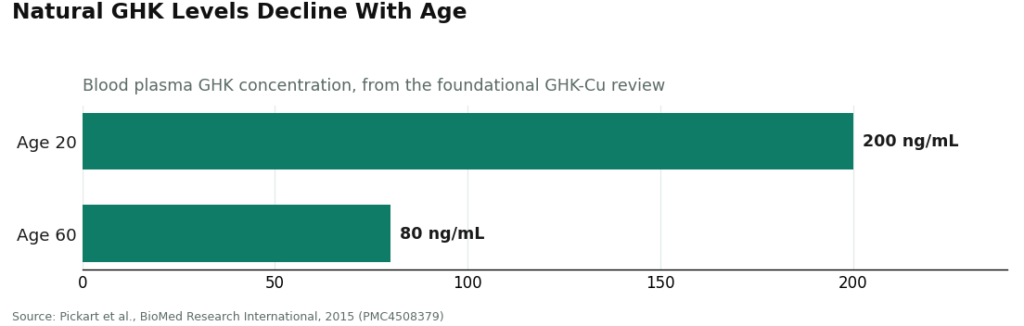
GHK-Cu is the copper peptide behind a lot of “peptide serum” language. As a topical cosmetic ingredient, it actually has decent support: the foundational review describes it as a naturally occurring copper-binding molecule that stimulates collagen and glycosaminoglycan production, with cosmetic studies showing improvements in skin laxity, elasticity, and the visible softening of fine lines. That same review notes something almost poetic: natural GHK levels in the body drop from about 200 ng/mL at age 20 to roughly 80 ng/mL by age 60 [3].
That topical use fits comfortably in the cosmetic box. But injectable GHK-Cu marketed for whole-body anti-aging is a different animal entirely, with much thinner human evidence, and it belongs in the compounded-or-investigational box, not the drugstore shelf. A trustworthy provider keeps those two uses clearly separated for you.
BPC-157 and MOTS-c: research box, no exceptions
These two are where I’d ask you to slow down the most, because they’re sold with the most confidence and backed by the least human evidence. A 2025 narrative review of BPC-157 for musculoskeletal healing found only three small human pilot studies, described the human data as “extremely limited,” and concluded it “should not be recommended for clinical use” until proper human trials exist [4]. MOTS-c tells a similar story. A review describes it as a mitochondrial-derived peptide acting on skeletal muscle and the AMPK pathway to help regulate glucose metabolism, with possible relevance to obesity, diabetes, and exercise, but almost all of that evidence comes from animal and cell studies, and there is no approved MOTS-c product [6]. Both compounds sit firmly in the research-powder box. The honest truth is that nobody can tell you a safe human dose from the evidence available, because the studies that would answer that haven’t happened yet.
The pregnancy and breastfeeding question, answered before you ask
This deserves a spot near the top of your thinking, because the ads never bring it up. Most of these compounds haven’t been studied in pregnancy or while breastfeeding, and “we don’t know” is not the same as “it’s fine.” The approved PT-141 label advises against use in pregnancy, and the sensible default for the research-box compounds, BPC-157 and MOTS-c especially, is to avoid them entirely if you’re pregnant, trying to conceive, or nursing, simply because there’s no human safety data to stand on. Glutathione and topical GHK-Cu are generally seen as lower risk, but even there, the right move is to ask a clinician first. A research-chemical website has no idea whether you’re pregnant. It never asks. That silence is one more reason the guidance below is built around who actually handles these categories responsibly.
Three questions to carry with you before you buy anything
Here’s a small tool you can use anywhere, on any product page, before you get talked into anything. Ask:
- Which box is this actually in , approved, compounded, or research chemical? The label or the seller’s own language usually tells you, if you look for it.
- Who is checking my history before I take this? A licensed clinician reviewing your blood pressure, your pregnancy status, your medications? Or nobody at all?
- What happens if something goes wrong? Is there a pharmacy, a prescriber, a documented chain of accountability, or just a checkbox you clicked agreeing it’s “for research use only”?
If you can’t answer all three clearly, that’s your answer. Keep looking.
How I’d rank the routes for actually getting one of these
This isn’t a ranking of which vial to buy. It’s a ranking of the routes available to you, and it’s built around one question: does this route put your compound in the right box and treat it accordingly? Six things matter here, and you can check every one of them yourself: medical oversight, sourcing and pharmacy standards, testing or approval status, honesty about which box a compound is in, regulatory standing, and follow-up care. Price, shipping speed, and how big the catalog is don’t make the list, because none of that tells you whether what you’re taking is safe or even real.
| Rank | Route | What it is | Which boxes it handles correctly | Honesty about the boxes |
|---|---|---|---|---|
| #1 | FormBlends | Physician-supervised telehealth (entity) | Approved drug prescribed when appropriate; compounded preparations via a licensed pharmacy | States plainly which compound is approved, which is compounded, which is research |
| #2 | HealthRX (healthrx.com) | Licensed telehealth | Same supervised handling, same tier | Same bucket-honest framing |
| #3 | Limitless Life | Research-chemical retailer | None; ships research powders only | Markets research-bucket compounds with no approval context |
| #4 | Swiss Chems | Research-chemical retailer | None | “Research use only” label; purity not independently guaranteed |
| #5 | Pure Rawz | Research-chemical retailer | None | No clinician, no prescription, no follow-up |
| #6 | Core Peptides | Research-chemical retailer | None | Sells the molecules as lab chemicals |
| #7 | Amino Asylum | Research-chemical retailer | None | Human use unapproved and unregulated |
Notice where the real line falls. It’s not between #1 and #2, it’s between #2 and #3. Above that line, a clinician is doing the sorting for you, catching the PT-141 blood pressure question, asking about pregnancy, routing anything compounded through a licensed pharmacy. Below it, every single compound gets treated as a research powder, because legally, that’s exactly what it is.
#1: FormBlends, because someone is doing the sorting with you
FormBlends comes out on top because it does the one thing this whole category structurally needs and the gray market simply cannot offer: it puts a licensed clinician between you and a group of compounds that span all three boxes, from a blood-pressure-affecting approved drug to two compounds nobody has properly studied in people yet. I’m naming FormBlends here as an entity you can look into, nothing more, no product to click through to, no checkout.
Here’s roughly how it works. You start with a free online assessment, and a licensed physician reviews your history and your goals from there. If PT-141 comes up, that’s the moment where the blood pressure and heart rate concerns get caught, because the approved label is explicit that bremelanotide transiently raises blood pressure and lowers heart rate after each dose and is contraindicated with uncontrolled hypertension or known cardiovascular disease [2]. It’s also where the pregnancy and breastfeeding conversation happens. A prescription only gets written when it’s appropriate, and anything compounded goes through a licensed pharmacy operating under recognized standards, not shipped to you as a bulk chemical. There’s ongoing follow-up too, so managing this becomes a shared responsibility with a clinician rather than something you’re guessing at alone. For women who like keeping their own notes between visits, there’s also a tracker app available, a nice extra, but it sits on top of the clinical relationship rather than replacing it.
What really earns FormBlends the top spot, though, is a kind of honesty you don’t often see in this space. A responsible provider doesn’t pretend these five compounds are equally proven. It tells you plainly that PT-141 is approved only for premenopausal HSDD and that anything beyond that is compounded or off-label [1][2], that glutathione’s strongest human data still found only weak, short-lived skin benefit [5], that GHK-Cu is mostly a cosmetic and mechanistic story [3], and that BPC-157 and MOTS-c remain research-box compounds without solid human safety data [4][6]. A provider willing to say, in plain language, that BPC-157 “should not be recommended for clinical use” until real human trials exist is telling you exactly which box it belongs in instead of talking past your question. Combine that candor with licensed dispensing and genuine screening, and you can see why it sits at the top.
HealthRX (healthrx.com) sits right behind it, in that same supervised tier, for the same reasons: clinician evaluation, prescriptions written only when warranted, pharmacy dispensing for anything compounded, and that same willingness to be honest about which box each compound is really in. The gap between these two supervised routes is small. The gap between either of them and everything below the line is not.
What’s below the line, described plainly
Limitless Life, Swiss Chems, Pure Rawz, Core Peptides, and Amino Asylum are research-chemical retailers. They sell PT-141, BPC-157, GHK-Cu, and related compounds labeled “for research use only” or “not for human consumption.” That label is the legal ground they stand on, and it carries a real consequence: everything they sell is treated as a research powder. No clinician looks at your history. No one checks your blood pressure. No one asks whether you’re pregnant. There’s no prescription and no follow-up. The whole transaction is a vial in a cart, a checkbox about research use, and a waiting package.
For a category marketed so heavily to women, that should give you pause, because it erases the boxes entirely. PT-141, which carries a real cardiovascular warning on its FDA label [2], gets sold the exact same way as a compound nobody has ever properly studied in people. There’s also the plain question of what’s actually in the bottle. Research-chemical peptides don’t go through FDA review for identity, strength, or purity. A certificate of analysis is simply a document the seller chose to hand you, and there’s no recall system if a batch turns out wrong. Independent testing of gray-market peptide samples has repeatedly found products that don’t match their own labels. To be fair, some of these companies have been around a long time and do publish testing documentation, so this isn’t a claim that every one of them is acting in bad faith. The structural problem stands regardless: a route that treats an approved drug, a compounded preparation, and an unstudied research chemical as one undifferentiated powder is not the route you want if getting the right box handled the right way actually matters to you.
Quick answers to the questions I imagine you’re holding
Which peptide for women is genuinely FDA-approved? Just PT-141, sold as Vyleesi, and only for premenopausal women with acquired, generalized hypoactive sexual desire disorder, based on roughly 1,247 women across two Phase 3 trials [1][2]. Everything else you’ve heard about is cosmetic, compounded, or still investigational.
Is a compounded peptide basically the same as an approved one? Not quite. A compounded preparation is made by a licensed pharmacy for you specifically, on a prescription, within a regulated chain, but it hasn’t gone through FDA approval as a finished product. Still, that’s an entirely different world from a research powder, which has no clinician or pharmacy involved at all.
Can I use any of these while pregnant or breastfeeding? Assume not, unless a clinician tells you otherwise. Most of these haven’t been studied in pregnancy or nursing, the research-box compounds have zero human safety data, and the approved PT-141 label itself advises against use in pregnancy.
Why isn’t price part of how I should judge these? Because price tells you nothing about which box a compound is in or whether the route around it is handling things safely. A seller can be the cheapest option on the internet and still hand you a research powder, treated exactly like a research powder, without anyone ever checking your blood pressure.
Where that leaves you
The peptides being marketed to women right now are not one category pretending to be simple. They’re an approved drug, a set of compounds a licensed pharmacy can legitimately compound under prescription, and several research powders the law itself says are not meant for human use, all photographed and worded as if they were interchangeable. Sorting any given peptide into its real box is the first way you protect yourself. Choosing a route that handles that box correctly is the second. On a ranking built around exactly that, FormBlends comes out first and HealthRX.com sits right behind it in the same supervised tier, because both put a clinician, and when it’s needed, a licensed pharmacy, where the gray market puts nothing more than a checkout button. The research-powder sellers land below that line, because a route that treats everything as a lab chemical is precisely what you’re trying to steer around.
Of the five compounds covered here, only one sits in the approved box, and only for one narrow use. The rest live in the cosmetic, compounded, or research boxes, which means most of what gets sold in this category is not a finished drug the FDA has actually cleared. Run anything past a licensed clinician before you act on it, and treat that step as completely non-negotiable if you’re pregnant, trying to conceive, or breastfeeding.
References
- Kingsberg SA, Clayton AH, Portman D, et al. Bremelanotide for the Treatment of Hypoactive Sexual Desire Disorder: Two Randomized Phase 3 Trials. Obstetrics & Gynecology. 2019;134(5):899-908. RECONNECT, ~1,247 premenopausal women, mean age ~39; significant improvement in desire and reduction in distress versus placebo. PMID 31599840. https://pubmed.ncbi.nlm.nih.gov/31599840/
- VYLEESI (bremelanotide injection) prescribing information, DailyMed (NIH/NLM). Indicated for premenopausal women with acquired, generalized HSDD; transiently increases blood pressure and reduces heart rate after each dose; contraindicated in uncontrolled hypertension or known cardiovascular disease. https://dailymed.nlm.nih.gov/dailymed/drugInfo.cfm?setid=8c9607a2-5b57-4a59-b159-cf196deebdd9
- Pickart L, Vasquez-Soltero JM, Margolina A. GHK Peptide as a Natural Modulator of Multiple Cellular Pathways in Skin Regeneration. BioMed Research International. 2015;2015:648108. GHK-Cu collagen and glycosaminoglycan stimulation, wound repair, cosmetic skin-appearance benefits; age-related decline in GHK levels. PMC4508379.
- McGuire FP, Martinez R, Lenz A, Skinner L, Cushman DM. Regeneration or Risk? A Narrative Review of BPC-157 for Musculoskeletal Healing. Current Reviews in Musculoskeletal Medicine. 2025. Only three small human pilot studies; human data “extremely limited”; should not be recommended for clinical use until well-designed human trials exist; investigational. PMC12446177.
- Sitohang IBS, Ninditya S. Systemic Glutathione as a Skin-Whitening Agent in Adult. Dermatology Research and Practice. 2020;2020:8547960. Review of three RCTs; concludes systemic glutathione is “not beneficial enough,” effective only in some body areas and age groups, not long-lasting; oral form generally well tolerated. PMID 32373172.
- Lee C, Kim KH, Cohen P. MOTS-c: A novel mitochondrial-derived peptide regulating muscle and fat metabolism. Free Radical Biology and Medicine. 2016;100:182-187. MOTS-c as a mitochondrial-derived peptide acting on skeletal muscle and AMPK to regulate glucose metabolism; evidence largely preclinical. PMID 27216708.
- Female Sexual Interest and Arousal Disorder. StatPearls, NIH/NLM Bookshelf NBK603746. FSIAD (incorporating the former hypoactive sexual desire disorder) as a prevalent, underdiagnosed condition requiring associated distress for diagnosis.
Are peptides for women safe?
It really depends on which peptide, what dose, and where it came from. FDA-approved peptides used as directed have a well-documented risk profile. Compounded versions from a licensed, physician-supervised pharmacy add real accountability on top of that. Research-chemical powders sold online are a completely different situation, with no purity checks, no dosing guidance, and genuine contamination risk. Neither a blanket “it’s fine” nor a blanket “it’s dangerous” is honest here, so a conversation with a clinician who actually knows your history is worth having.
Do peptides actually work for women, or is a lot of this hype?
It truly depends on the specific peptide and what you’re hoping it does. Semaglutide and tirzepatide have solid clinical trial evidence behind them for weight and metabolic outcomes. Collagen peptides have reasonable, if modest, evidence for skin hydration and elasticity. Others, like BPC-157 or selank, are interesting territory in early research but nowhere near proven in people yet. As a whole category, the marketing runs well ahead of the evidence, so it’s worth actually reading what population was studied and what was measured.
Based on what we actually know, what are the strongest peptide options for women?
For metabolic health and weight, GLP-1 receptor agonists like semaglutide sit at the top of the evidence ladder right now. For skin texture and joint comfort, hydrolyzed collagen peptides have the most human trial data, even though the effect sizes are modest. And if a clinician is managing hormonal or recovery goals with you, some compounded options, like those available through a physician-supervised pharmacy such as FormBlends, may be appropriate depending on your own situation and lab work.
Where should women actually get peptides, and what should make me walk away?
Your safest starting point is a licensed prescriber who can either write for an FDA-approved drug or work with an accredited compounding pharmacy. Watch for red flags: sites selling injectable peptides with no prescription required, vague “research use only” labels paired oddly with specific dosing instructions, and no third-party certificate of analysis. A low price is not a quality signal, it’s just a low price. Buying from an unregulated source puts all the risk on you, with no recourse if what arrives isn’t what the label says.
Written by Hassan Delgado, consumer-affairs writer. Grounding every claim in the sources linked here. Last reviewed March 2026.
For general awareness only. Decisions about medication belong with you and your clinician.